
SEOTEC INSIGHTS BARBERSHOPS / NEW YORK
Barbershop SEO: Help Clients Choose a Cut, a Barber, and a Time
Picture a new customer leaving work near Manhattan's Flatiron District. They want a clean fade before the weekend. A nearby shop appears on Google with good photographs and a booking button. The menu says “Haircut,” the appointment screen offers several unfamiliar names, and none of the photographs identify who did the work. The shop is visible. The customer still has to guess.
That gap is where a barbershop website earns its keep. People are choosing something more specific than a storefront. They may want a familiar barber, a particular kind of cut, a service that fits their schedule, or a walk-in option that will actually be available. Local search can get them to the front door; the website and booking system have to make the next choice possible.
For the owner, this changes the order of work. A higher position for “barbershop near me” has limited commercial value if the best-selling services are unclear, a barber's portfolio leads to the wrong schedule, or Google and the site disagree about when the shop accepts clients. Start by understanding the chair a person is trying to reach. Then decide which search and website improvements deserve investment.
Four choices sit behind one haircut booking
A visitor normally needs to reconcile four pieces of information: the cut, the barber, the shop location, and an available time. The order varies. A regular who only trusts one barber starts with the person. Someone interested in a low taper may start with photographs. A commuter who has thirty minutes between appointments may begin with time and location. A customer who wants to walk in may not want a booking calendar at all.
The website cannot assume one route fits everyone. Yet it should not make visitors repeat the same choices in several separate systems. If they pick a barber from a portfolio, the booking step should carry that barber forward where the software allows it. If they select a longer haircut-and-beard service, the next screen should not silently reduce it to a basic cut. If the shop operates more than one real location, the customer needs to know which chair the appointment belongs to.
A useful test is deliberately small: ask a person unfamiliar with the shop to find a specific service and book it with an appropriate barber, using only their phone. Watch where they pause. When they have to call to check basic information, the website is exposing a gap that a new SEO page alone will not repair.
Google Maps can introduce the shop; it cannot explain every cut
A Google Business Profile provides the public essentials: the shop's real name and address, category, opening hours, photographs and customer feedback. Accurate information matters because people often make a local choice without opening several websites. A business using appointment links can also direct customers to a booking destination, and Google allows eligible profiles to select a preferred link when several are present. The available link types and controls follow Google’s current rules.
The profile and website have different amounts of space to do their jobs. Google can display a concise service list, but the website can explain what the shop actually means by “fade,” “shape-up,” “scissor cut,” or “beard detail.” It can show which barbers have relevant examples, whether the service is offered at every location and how the correct appointment is selected. A useful site gives the profile somewhere honest and specific to send a visitor.
Keep the booking link itself under review. Google notes that certain third-party booking partners may appear on profiles and have their own opt-out procedures. That matters when a shop has changed systems and an older link still sends people into a calendar the staff no longer manages. A wrong booking destination can cost a customer before they ever discover how well the shop cuts hair.
This is also the point to resist location-name games. Google asks businesses to use their real-world name and a real, eligible location. A shop in Chelsea should describe itself truthfully, not rename the business “Best Manhattan Fade Barber Chelsea NYC” to collect extra words.
Your service menu is also a time contract
A menu is often written as though every line were a product label. For a barber, it also defines the appointment's scope and the time allocated to it. “Haircut” may cover several methods, while a detailed skin fade or combined haircut-and-beard appointment may need a different reservation block. The right structure follows the actual shop operation, rather than a universal list of trendy haircut names.
Suppose the shop offers a standard cut, a precision fade, a beard trim and a haircut-with-beard combination. Explain which services are materially different, what is included, how prices are presented, and which barbers are available for each. If two labels are interchangeable in practice, the website can explain that without turning each phrase into a separate SEO landing page. If they require different skills or appointment lengths, that difference belongs where the customer makes the choice.
| What the visitor sees | What the shop needs to make clear |
|---|---|
| Haircut / scissor cut | What the service includes and which hair types or styles it is intended for, where relevant |
| Fade or taper | Whether this is a distinct appointment option, and whether a consultation is needed to choose a finish |
| Beard trim or line-up | Whether it can be booked on its own and what is included |
| Haircut + beard | Whether the combined service reserves sufficient time and is priced as a combination |
| Children's cut, if offered | The shop's actual age or service policy and which barbers take the appointment |
Those are examples, not a required menu. If the shop does not offer a named service, do not create a page claiming it does. Display accurate prices or clearly identified starting prices, with a short explanation of what can change the total. A phrase such as “prices vary” is less useful if it offers no clue what is being quoted. Staff should recognize every service label on the public website and inside the booking software.
When customers routinely book the wrong length of appointment, the solution is unlikely to be a longer SEO article about fades. It is a better definition at the moment of selection.
A barber profile should show the work, not merely the team
A group photograph and first names establish that people work at the shop. They do little for a customer who wants to know whether a particular barber handles textured hair, longer scissor work, a sharp shape-up or a traditional beard service. A useful profile gives a little of the barber's working vocabulary, explains specialties the shop can verify, and connects the person to actual examples of their work.
The photographs matter here because haircut quality is visible, but they need context. A cropped image of an immaculate fade with no barber credited is a decoration. The same authentic image, attached to the barber who created it and identified as a particular style, helps someone make a choice. The shop should have permission to publish identifiable clients and should avoid retouching or swapping examples in ways that misrepresent the work. No imaginary portfolios, borrowed “results” or stock headshots presented as the current team.
Keep the booking route connected to each barber's profile when the shop's scheduling system supports it. The link should lead to the right professional, services they actually perform, the correct location, and genuine availability. Test that journey on a phone before assuming it works for customers.
Profiles also need maintenance. When someone changes shifts, leaves the shop or changes locations, the page should be corrected before another client lands there through search. Maintaining a small number of honest profiles is better than publishing dozens of interchangeable “best barber” bios that no one at the shop can keep accurate.
Three visitors need three different paths
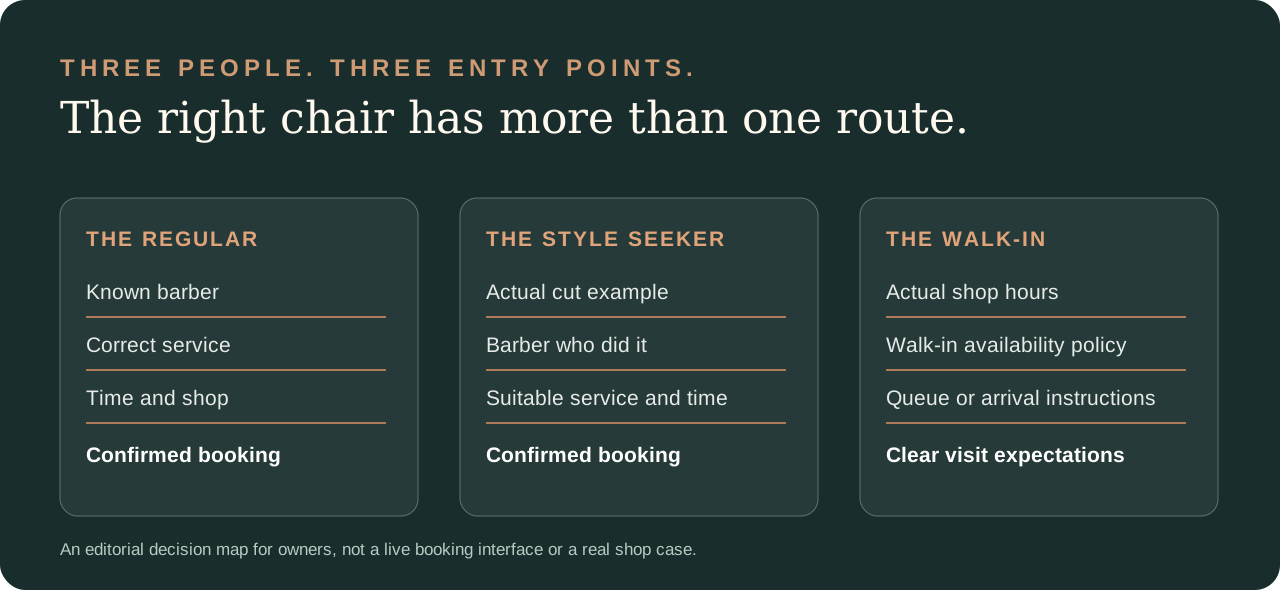
Consider the visitor who knows the barber by name. They may have followed that barber from a previous shop and only need to verify the current location and book a cut. Sending them through a generic gallery and then asking them to select a barber again wastes the one thing they already decided. The shortest credible path is barber → available service → correct location and time → confirmation.
The visitor who knows the style but not the person has a different job. They want to see real work, understand what kind of appointment it is, and choose someone who performs it. Their path is service or style → actual barber examples → appropriate appointment → confirmation. A gallery can begin this journey, but every useful example should offer a way to reach the service or professional it represents.
The third visitor wants to walk in. A calendar may be the wrong answer entirely. They need the shop's current opening hours, physical location and a truthful description of how walk-ins work. The path is shop and hours → walk-in policy → arrival instructions or live queue, if genuinely available. If the wait is not published in real time, do not simulate a countdown or show “available now” because the owner hopes to fill a chair.
These paths are worth showing separately on the website. It can be done with ordinary links and accurate labels, without creating three websites. The useful question is where each route ends. A style page that drops someone onto a booking homepage with all decisions reset has not completed its job.
The booking handoff is where good websites can become confusing
Booking software handles real operational tasks: availability, service duration, deposits, reminders, cancellations, and staff schedules. It does not automatically repair an unclear website. An attractive “Book Now” button may open the provider's storefront, which is fine if the customer can carry forward the service, barber and location they were considering. Some integrations preserve those selections; others may require a different link or configuration.
Test the handoff in the order customers encounter it. Open the haircut page on a phone, choose a barber, and proceed to the booking provider. Does the destination still show that barber? Is the requested service bookable with that person? Are there real times, a clear location and the correct cancellation conditions? If the first time offered is at another branch, is the switch obvious? If the provider requires a deposit, is the policy visible before payment?
A finished booking is not the same as a click. Confirmation means the booking provider or shop has actually accepted a time. A button press, appointment-selection page view, abandoned deposit or submitted request does not establish that outcome. Use accurate button wording at each stage, and make the next step clear if the shop must approve a request manually.
Walk-ins deserve their own honest answer
Walk-in service is a real part of some barbershop businesses. It should not disappear from the website simply because the booking vendor offers a prominent appointment button. Nor should “Walk-ins welcome” imply that a specific barber is sitting idle all afternoon.
An effective walk-in explanation says whether the shop accepts them, during which hours, how the queue works and whether every service or barber is available without an appointment. If the shop runs a live waitlist, provide the actual status and state what it means. Otherwise, use stable language such as “Walk-ins are welcome when chairs are available; appointments are recommended for a specific barber.” That language is a sample of a truthful policy, not an assumption about any shop.
The two routes can coexist. Make it possible to book a preferred barber and also to understand the walk-in process without forcing both visitors through the same calendar. A shop that primarily works by appointments can say so directly. Clear expectations are part of service quality, not just conversion copy.
Manhattan is a place customers move through, not a keyword prefix
A person working near Penn Station, someone living in Chelsea and someone crossing from Brooklyn may all compare shops in Manhattan, but their practical questions differ. Can they reach the shop from work? Is the address in the neighborhood the site describes? Does the barber they want work at that specific branch on the day they can go? Is there enough time before the next train or appointment?
The right local page starts with the real storefront. A Manhattan barbershop should have accurate hours, a usable street address and map link, nearby wayfinding when helpful, and the services and barbers actually available there. If a business has an additional, genuinely operating Brooklyn shop, each location can justify its own information. If it has only one Manhattan address, a set of near-identical pages for Chelsea, Flatiron, SoHo and Midtown will not create four separate shops.
A separate neighborhood guide can sometimes answer a legitimate question, such as what kinds of appointments a shop offers for people working late near that location. It needs real distinct information beyond swapping a place name. Otherwise the shop page and the service pages can do the work together, supported by accurate Google Business Profile details. Google explicitly requires profiles to describe actual eligible business locations rather than virtual address shortcuts.
Manhattan deserves real attention in this industry, including as a competitive place for barbershops. It should not become a decoration repeated in every heading. A client deciding where to go needs the precise location and relevant service more than fifteen variations on “best Manhattan barber.”
A gallery needs captions, not just a filter
For a barber, photographs are often the most persuasive part of the website. That is a reason to treat them with more care, not less. The shop's real work should be shown clearly enough that someone can judge the shape, finish, texture and detail that matter to that style. Good lighting and sensible cropping help; heavy edits that change the appearance of the result undermine the point of showing evidence.
A short, useful caption can connect the photograph to a named style, a relevant service, the barber who performed it and, if appropriate, a detail about the process. Not every picture needs a mini-essay. A customer should be able to tell whether the image is a haircut the shop actually offers and whether they can book the person who did it. Obtain and maintain appropriate client permission for identifiable photographs. Remove a photo or attribution if that permission changes.
This does not require pretending to have a spectacular before-and-after transformation for every service. Clear examples of actual finished cuts can be more useful than theatrical comparisons. If there are too few real examples for a claimed specialty, say less about it until the shop has real work it can show.
Google reviews provide another kind of evidence: an account of someone's experience. They should remain genuine and unbiased. Google prohibits paid or incentivized reviews, selectively soliciting only favorable feedback, and manipulating ratings. The shop can encourage legitimate feedback after service without inventing testimonials or scripting customers into keyword-rich praise.
Use an actual client-approved
cut photograph here
The license behind the team is more than a badge
For shops operating in New York, it is important to distinguish the business from the person performing barbering services. New York's Department of State explains that the barber shop owner's license does not authorize a person to practice as a barber; operators need their own licensing, and certain independent barbers renting space need an area-renter license.
In New York City, the Health Department separately issues Barber Shop Permits for operating a barber shop. The city describes its own permit and inspection requirements. This is an operational and factual distinction, not a claim that a license badge directly improves search rankings.
For a website, the consequence is straightforward: identify the actual shop and its operating people truthfully. Do not imply that a licensed owner personally provides every service, that an independent renter is a staff employee, or that an apprentice has qualifications they do not have. Confirm how a business wants to describe roles before publishing bios or service claims. The website should match the real operation.
Measure the haircut that was completed, not the booking button
The site owner needs to know whether online visibility is delivering useful work to the shop. Search Console can show Google search impressions and clicks. The business profile can show certain interactions, and website analytics can measure visits or events, depending on its setup. The booking system holds a different set of records: appointment selections, confirmed reservations, cancellations, completed visits and, sometimes, rebookings. None of those stages is interchangeable.
Consider a hypothetical, consistently tracked cohort of 40 booking starts from a particular week. Suppose 24 become confirmed appointments, 20 are marked completed, and eight of those completed visits lead to a future reservation. The figures are not 92 customers. They show where a given cohort moves and where a question needs investigating. A shop unable to connect these systems should keep unknown attribution unknown, rather than attributing every completed haircut to SEO.
For an established barber, repeat customers may be a substantial part of the business. A booking system can sometimes show repeat bookings and no-shows more reliably than a website analytics dashboard. A regular booking again is a meaningful business outcome, but it is not necessarily a new customer generated by a particular search query. Give repeat activity its own place in reporting.
The interesting failures appear when two systems disagree in a useful way. If Google visibility grows but booking starts remain flat, inspect the entry page and the clarity of services or staff. If booking starts increase but confirmations do not, examine the software handoff, available services and deposits. If confirmations increase while completed visits do not, look at scheduling, reminders and cancellations. Only after distinguishing those problems can a higher SEO budget be evaluated properly.
TWO-MINUTE SELF-CHECK
Could a stranger book your actual service?
This checklist stays in your browser. It does not collect customer or shop data.
A failed item identifies a specific task for the shop, not an SEO score or a Google ranking factor.
Which fix should come first?
A shop with missing or inaccurate Google hours has a straightforward factual repair to make. A shop with a strong profile but no explanation of its services has a content problem. A shop whose barber portfolios attract attention but whose booking links forget the chosen barber has a conversion-path problem. They require different work, even if all three owners initially ask for “better SEO.”
There is no need to rebuild every page because the Google ranking feels disappointing. Pick one real customer journey and trace it from the first result to the shop's record of the appointment. A useful sequence for an owner is to verify the listing and actual location, open the matching page on a phone, choose a service, choose the person if that matters, and complete the booking. For a walk-in route, check the posted hours and instructions against how the shop actually operates that day.
Then compare what happened with the shop's own evidence. If the appointment cannot be made, identify where the selection was lost. If the appointment is accepted but staff cannot accommodate it, repair the service or schedule configuration. If the website gives no reason to choose between barbers, improve the authentic portfolio before creating more generic location pages.
A barbershop is built around skill, a place and a recurring relationship. The website should preserve those things through the customer's decision. When a person knows which cut they want, which barber can do it and how to claim the right time, local search visibility has a much better job to do. The goal isn't a bigger “Book Now” button. It is fewer unanswered questions between finding the shop and getting into the right chair.
Sources and editorial scope
This guide is SEOTEC's editorial framework for barbershop owners. Scenarios and cohort figures are hypothetical, not measured client outcomes. Information about a particular shop's personnel, scheduling or licensing must be checked against its actual operation. Primary and first-party sources checked November 13, 2026:
- Google Business Profile: Manage your local business links: appointment links, preferred links and third-party providers.
- Google Business Profile: Guidelines for representing your business: actual business name and physical location.
- Google Maps: Fake and misleading review content: genuine reviews and prohibited manipulation.
- New York State Department of State: Barber licensing FAQ: shop owner, operator and independent area-renter distinctions.
- NYC Health Department: Barber Shop Permit: separate city permit and health requirements.
For the work around that decision, see SEOTEC SEO & Local Search, Content & Editorial and website development. These services have different roles from the appointment decision a barbershop owner must verify.