
SEOTEC SERVICES
AI Search Visibility
Make your business easier to find, understand and choose.
People can encounter a business in a search result, a generated answer or a list of sources. SEOTEC’s AI Search work examines those encounters: whether your business appears, whether its information is accurate and whether the pages behind the answer give a potential customer something useful.
You may hear this work called GEO, AEO or AI search optimization. The label is less important than the task. We connect content, technical access and clear measurement rather than treat a new acronym as a substitute for a working website.
What AI SEO, GEO and AEO mean
AI SEO can mean two different things: using AI tools to assist ordinary SEO work, or improving a business’s visibility in AI search. This service addresses the second meaning. The purchased work is a review and improvement of how your business can be found, described and supported by useful sources in relevant AI answers. The aim is useful, accurate representation and a better understanding of the customer activity that follows.
AEO stands for answer engine optimization. GEO stands for generative engine optimization. Both labels are used for work intended to improve visibility in AI search experiences. Google describes that work, for its own generative search features, as part of SEO. Google’s guide to generative AI optimization
You may see AEO used for answering a specific question and GEO for the broader way a brand is represented in a generated response. That distinction can help a conversation, but agencies do not use the labels consistently. They overlap; neither term defines a standard package or a guaranteed placement. An AEO proposal and a GEO proposal may contain much of the same work.
Which AI search experiences are in scope?
Google AI Overviews and AI Mode are features of Google Search. ChatGPT is a separate service with its own search access and referral behavior. A result observed in one is not evidence of visibility in the other. We name the platforms, business questions and pages in the scope so you know what is being reviewed.
For your business, the useful comparison is therefore between deliverables: which answers need attention, which sources or pages can be improved, who implements the changes and how progress will be assessed. Paying for two different acronyms should not mean paying twice for the same page edit.
Find the right problem before chasing mentions
Not every business needs the same AI search program. A local service provider may need accurate coverage and contact information. A specialist brand may need better explanations of its products. A company already receiving AI referrals may need to understand which pages and questions are bringing people in.
We begin with a defined set of relevant questions, drawn from the business, available search data and the decisions customers need to make. We record where and how those questions are checked. This gives the program an observable baseline instead of a collection of flattering screenshots.
The first review separates three situations: your business is not mentioned; it is mentioned but described inaccurately; or its pages are used as sources without the brand being a recommendation. Those call for different work.
Build on the site you already have
Google says its established SEO practices remain relevant to AI Overviews and AI Mode. Eligible supporting pages need to be indexed and eligible for a search snippet; there is no special AI schema or new AI text file required for inclusion. Google’s guidance on AI features
Google’s current guidance also requires the site to be included in Search generative AI features through its Search Console control. Inclusion is the default, although a property can inherit a parent’s choice. We review that choice as part of eligibility: an otherwise sound page can still be excluded. This setting is separate from ordinary Search ranking and AI-training permissions, and inclusion does not guarantee that a page will appear. Google’s Search generative AI control
Our work therefore starts with what can be inspected: accessible pages, useful main content, meaningful internal links and structured information that agrees with the visible page. We do not propose a separate shadow website written only for a model.
Search access and model-training permissions are also different decisions. OpenAI documents independent controls for OAI-SearchBot and GPTBot. Any crawler changes should reflect the owner’s actual choices, rather than opening or blocking everything labeled “AI.” OpenAI crawler documentation
Make important answers specific and supportable
A business page needs more than a claim to be the best. We look for the details that make an answer useful: what the service includes, who a product is for, where the business operates, what distinguishes an approach and what evidence supports it.
That might lead to a clearer service description, a comparison, a maintained guide or a documented case study. Sometimes the best work is removing ambiguity from an existing page rather than publishing another article.
The content should retain the brand’s voice. Clear does not mean mechanical. We organize material so a person can understand the important answer and investigate it further, with sources and limitations where they affect the decision.
Keep the business identity consistent
We review the relationship between the public brand, company information and relevant profiles. Conflicting descriptions, outdated contact details and unexplained naming differences create avoidable uncertainty for readers as well as systems that encounter that information.
Structured data can describe the facts, but it cannot replace them. The visible page remains the reference. We do not invent credentials, reviews or third-party recognition to fill a schema field.
Outside the website, we identify relevant sources and public information that may need correction or better explanation. The goal is credible representation, not a large number of artificial mentions.
Measure different kinds of visibility separately
A mention, a citation, a recommendation and a referral are not the same event.
| What we observe | What it tells us |
|---|---|
| Brand mention | The answer includes the brand’s name |
| Linked citation | The answer or source panel links to a page |
| Recommendation | The answer presents the business as an option for the stated need |
| Referral visit | An observable visit arrives from the platform |
| Enquiry or sale | A recorded business action follows, with the attribution available |
We keep the original question, platform, date and visible answer with the observation. Repeated checks can show patterns within that sample. A single inclusion is useful evidence, but it is not a market-wide visibility score.
Referral analysis uses the source and campaign information actually available in your analytics setup. A visit attributed to ChatGPT and a saved ChatGPT answer establish different events; neither alone proves which answer prompted a customer to contact you. Traffic reports and answer observations still answer different questions.
Google AI impressions and business results
Google’s Generative AI performance report adds a direct view of impressions from AI Overviews and AI Mode. It can show which pages received impressions, with date, country and device comparisons. It is an impressions report, not a separate report of AI leads or sales. Google says it may be absent when a site has not received enough impressions. Google’s report documentation
Where access and data permit, we use that evidence alongside the defined answer checks and available referral/conversion data. A useful review can show that a particular page became more visible while also showing that too few measurable inquiries have followed to judge commercial value. Those findings should remain distinct.
Read the guide to mentions, citations and referrals
Historical Google AI Mode evidence
- Query
- “vanilla perfume”
- Observed
- An IRFĒ article in the linked source panel
- Source
- IRFĒ report, September 6, 2025 · page 5
This capture records source inclusion. It does not establish a recommendation, referral, lead, customer or ranking guarantee.
View the full original ↗Query and Google AI Mode
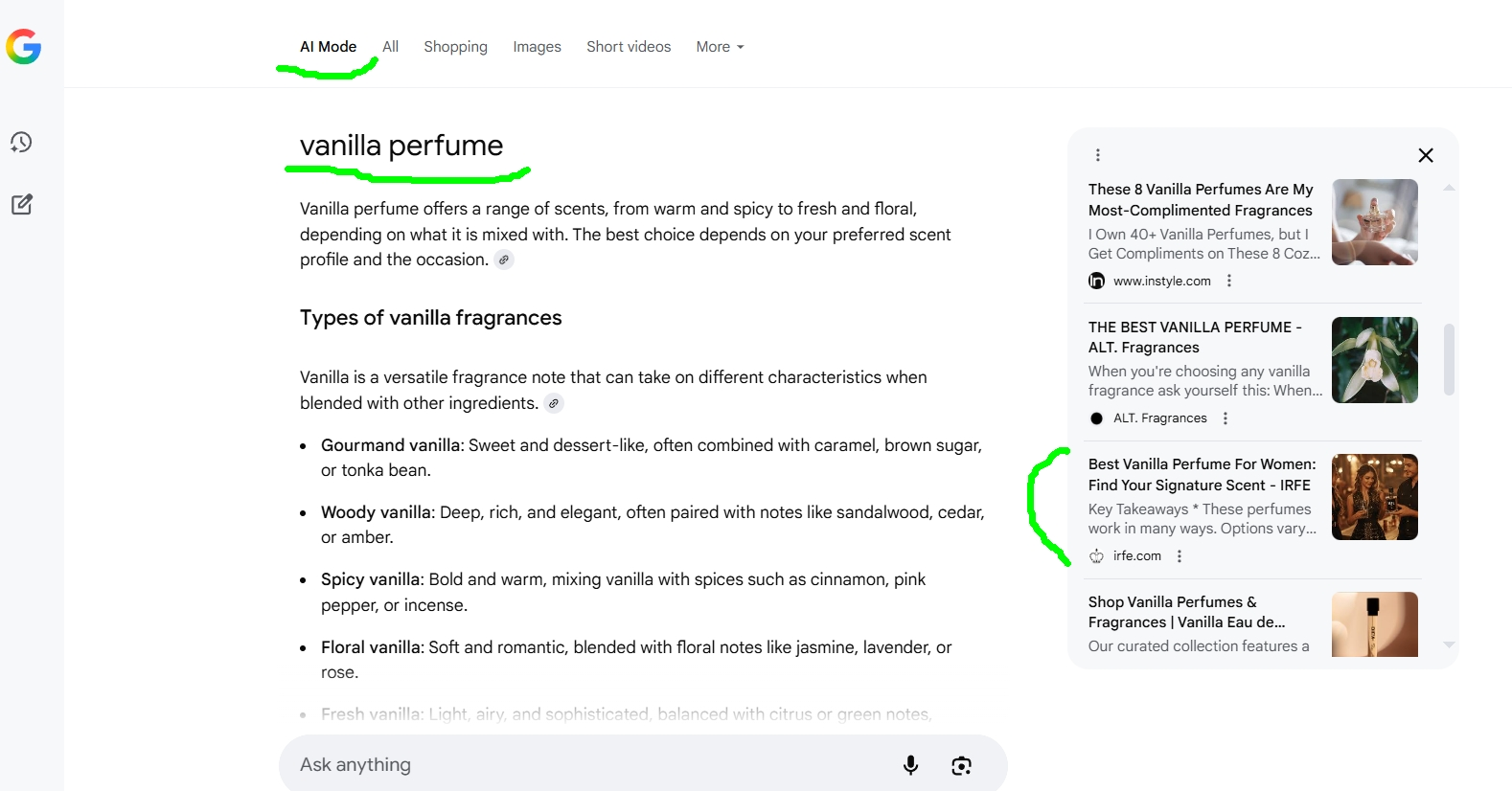
IRFĒ in the source panel
Inspect the complete original screenshot
A real example from IRFĒ
The IRFĒ archive includes a saved Google AI Mode answer for “vanilla perfume,” with an IRFĒ article in the linked source panel. It is a useful example of editorial content becoming part of an AI search experience.
A practical sequence of work
Review the baseline
We examine relevant answers, available referral data and the pages associated with your services or products. The scope names the platforms and questions being considered, rather than promising to monitor every possible conversation.
Identify the missing information
We distinguish problems of access, inaccurate business information, weak explanations and missing evidence. The recommendation states what can be changed and why it is a reasonable next step.
Improve the right pages
The agreed work may involve service content, a product explanation, a guide, internal links or technical configuration. Existing useful content is retained. Any changes to access controls are checked before deployment.
Check again and interpret the result
We return to the defined questions and inspect observable changes. Reports separate what was changed, what was seen and what remains an interpretation. A platform update or a different question can change an answer, so comparison conditions matter.
What you receive from the work
A defined engagement connects the observations to work you can inspect. The agreed deliverables can include a baseline of the questions and platforms reviewed, saved examples of inaccurate or incomplete answers, and an assessment of the relevant website pages and public business information.
The resulting action plan identifies the affected pages or information, the problem each change addresses, and who will implement it. Where content work is included, the deliverable is the revised service explanation, product information, comparison or evidence page itself. Where another team owns implementation, it is a specific handover with a way to check the completed change. The scope distinguishes the review from any writing and development work.
Consider a service business that appears in an answer but is described as serving the wrong area. The immediate task is to find and correct the conflicting public information, then check the relevant answers again. Publishing a large collection of new articles would not directly resolve that problem. A brand with accurate information but weak explanations of its products may need a different scope, centered on useful product and comparison content.
The follow-up records what was changed, what was observed afterward and what remains unresolved. Delivering an approved improvement is within the project’s control; earning a citation, a recommendation or a customer remains an outcome to observe. That distinction lets you evaluate the work even before there is enough traffic to evaluate revenue.
Scope, cost and expectations
An AI visibility diagnostic, an implementation project and an ongoing review program buy different work. A diagnostic establishes the starting point and priorities. Implementation pays for the agreed content or technical changes. Ongoing work adds repeated observations, maintenance and further improvements as the business and search experiences change. A monitoring subscription by itself does not include all of those services.
The scope and fee depend on the number of brands, services, locations and platforms involved, the questions that need review, the condition of the existing content, and who will make the changes. A single service business with conflicting contact information has a different task from a large catalog whose products need detailed explanations. More frequent checking also increases the monitoring work; it does not itself make an AI system more likely to choose your business.
SEOTEC assesses the website before recommending a paid scope. The proposal should state what is included, which implementation or recurring work is additional, and how it overlaps with an existing SEO program. Shared technical and content improvements should have one clear responsibility and budget. The price is for that defined work, rather than an AI-ranking position.
There is no fixed result date. Early reviews can verify that changes were delivered and information problems were addressed; a commercial assessment needs enough relevant visits and inquiries to interpret. We agree what evidence will be reviewed and when, so you can decide whether to continue, adjust the work or put the next budget elsewhere.
Useful for the right business, proportionate to the task
AI Search work can be a focused diagnostic or part of a broader SEO program. A small business does not need an enterprise-sized monitoring stack merely to begin checking its information. A larger catalog may justify a more structured set of pages, questions and data.
We choose the tools around the task and use existing data where it is sufficient. The deliverable is a clearer picture of the opportunity, an actionable set of changes and a measurement approach you can understand.
No agency controls which sources an AI system selects. We can improve the material and access it encounters, test the relevant questions and document the results; we cannot sell a guaranteed recommendation.
Questions about AI search optimization
Does AI search optimization replace SEO?
No. Our AI-search work builds on accessible pages, clear business information, useful content and a sound search foundation. The additional work is to check how the business appears in relevant AI answers and address specific information gaps, not to replace the website with an unrelated set of AI pages.
Does Google require special schema to include a website in AI answers?
No. Google does not require a special AI schema for its generative search features. We keep applicable structured data accurate and consistent with the visible page, while improving the content and technical foundations. Adding a markup type is not a guarantee that the page will be cited.
Can you guarantee that an AI platform will recommend my business?
No. We can improve the information a platform can find and evaluate, and track a defined set of relevant questions. We cannot control which sources it selects or promise the same answer to every user. Observed mentions and citations are reported with their context.
What will an AI visibility review actually show?
It can show where the business was mentioned, linked or recommended in the questions reviewed, which information was missing, and what page changes are worth considering. Observable referral visits and business actions are reported separately. A citation screenshot alone is not evidence of new customers.
Start with your website and your customers’ questions
Tell us what you offer, who you serve and what you want people to understand about your business. We will assess where ordinary website improvements, SEO and a focused AI Search review fit together.
Explore the foundations
AI Search Library · SEO & Local Search · Mentions, citations and referrals