
Content Strategy & Editorial Services
Content with a job to do. And a voice worth hearing.
A useful page should answer a real question, sound like the business behind it and give the reader a reason to continue. SEOTEC plans, writes and edits website content around those three responsibilities. We work on service pages, supporting guides, product and category copy, and existing articles that need more than another paragraph of keywords.
The work connects editorial judgment with your website structure and search priorities. You receive content that can be implemented, not a spreadsheet of topics left for someone else to interpret.
Start with the pages your business actually needs
A content plan begins with what you sell, who buys it and what they need to understand before contacting you. A service page should explain the offer. A guide can answer a deeper question. A case study should show evidence. Giving each page a clear role helps avoid several versions of the same thin answer.
We review the material already available before proposing new pages. Some content deserves a better introduction or clearer examples. Some needs a more substantial rewrite. Other topics belong inside an existing page rather than at another URL. The recommendation includes the reason for the change, the intended reader and the next useful step.
For a local service business, this might mean a stronger core service page and a small group of practical supporting articles. For an ecommerce business, it might mean clearer category copy, better product explanations and editorial material connected to the catalog. The plan follows the business rather than a fixed quota of articles.
Research before writing, judgment before publishing
We examine the questions behind a topic, relevant search results, existing client material and sources that can support specific claims. Competitor pages help reveal what a reader is likely to expect. They are not a script to copy, and their word counts are not an instruction to pad your page.
The brief records the primary question, the scope, the supporting evidence and the links the finished piece needs. Information that only you can confirm, such as how a service is delivered or which results can be published, is separated from background research. That prevents a confident draft from turning an assumption into a business promise.
Writing then brings those inputs together in your voice. A fashion brand, a moving company and a technical consultancy should not sound interchangeable. We preserve useful detail and personality while removing repetition, unsupported claims and passages that do not help the reader.
explains a related question
supports a claim
New pages, substantial rewrites and ongoing editorial work
Content work can be a defined batch or an ongoing program. A scope may include service-page copy, supporting guides, ecommerce descriptions, editorial briefs, internal-link recommendations, titles and descriptions, or a review of material produced by another writer.
For existing articles, we identify what should stay before deciding what should change. A rewrite is not permission to discard useful examples, approved imagery, original reporting or the character of the brand. When consolidation or a URL change is appropriate, it is proposed explicitly rather than hidden inside an editing task.
Deliverables are organized for implementation: the full text, heading hierarchy, approved references, image guidance and the intended destinations of internal links. Publishing and website changes can be included in the project, but the scope states who does them. There is no handoff consisting only of "make the content better."
AI-assisted work still needs an editor
AI tools can assist with research, outlining and drafting. They do not decide what your company can claim, invent customer experiences or approve their own output. Our workflow includes source inspection, editing and review of the completed material before publication.
The point is not to erase every sign of a distinctive voice in pursuit of a generic "optimized" article. It is to use the tools without handing them editorial responsibility. Sensitive client information is not part of a public writing brief; access and handling requirements are agreed before private source material is used.
Evidence from the work
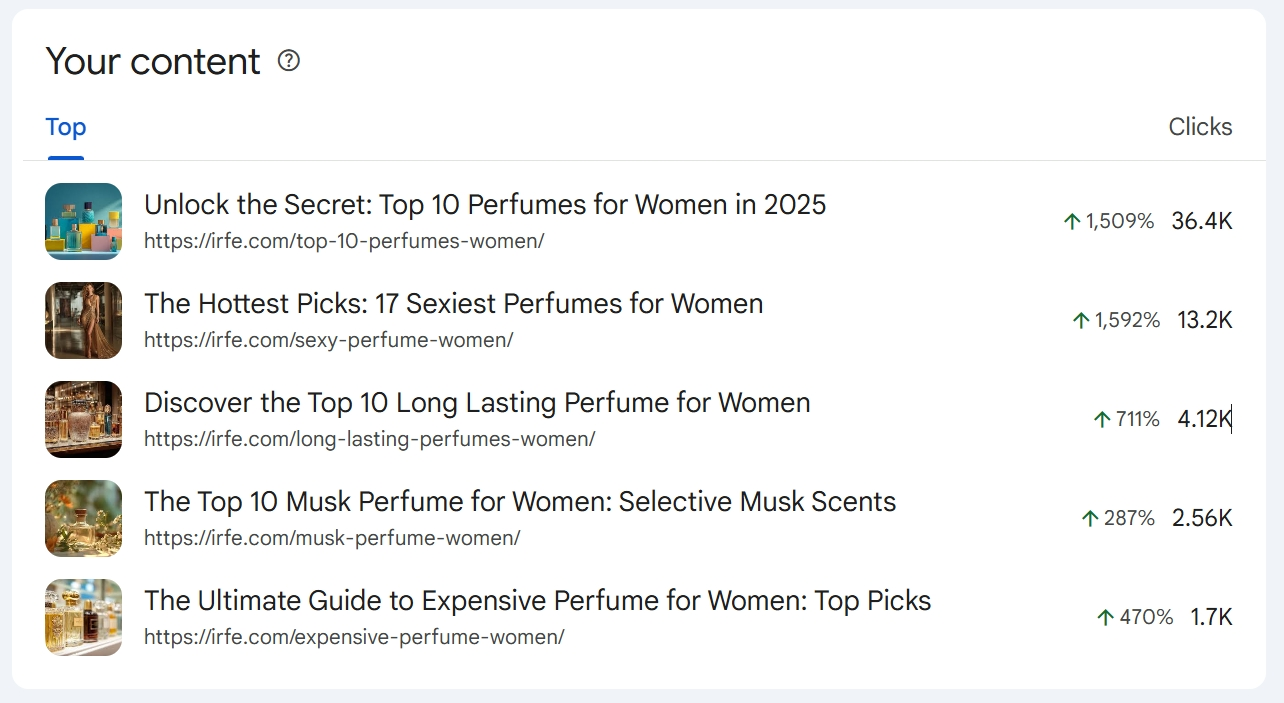
The IRFĒ case study documents search growth during a defined historical period, including strong performance by fragrance articles. It brings together original reporting, examples from search results and separate Discover evidence. Those results provide context for our editorial and search work, not a forecast of what every new article will achieve.
How a content engagement is organized
First, we agree on the audience, commercial priorities and source material. Next comes the page or topic map, followed by a brief for the work that has been selected. Drafts are reviewed for substance, accuracy, voice and their role within the site. You approve the business-specific facts and final publication copy.
The handoff identifies the pages involved, the copy to use and any implementation dependencies. For ongoing work, the next round is informed by performance and actual business needs rather than an automatic demand for more URLs.
The estimate depends on the research required, the condition of existing material, the number and type of pages, and whether implementation is included. Article counts, review rounds and delivery timing are agreed in the proposal. Advertising, outreach and a full website rebuild are not silently bundled into an editorial assignment.
Questions about content and editorial work
Can you improve existing pages instead of replacing them?
Yes. We review the role and useful material of an existing page before choosing a revision. The work may be a focused correction, a substantial rewrite or a new supporting page. Rewriting everything is not the default, and useful evidence should survive the edit.
Do you use AI to write website content?
AI can assist research, organization and drafting, but it does not replace editorial review. We check claims, sources, tone and the purpose of the page. A generated draft is not treated as finished copy simply because it is fluent.
What information and approvals do you need from the business?
We need accurate service or product information, relevant source material and an agreed approval contact. Business facts, offers and final wording are checked through the agreed review process before publication. Writing and implementation responsibilities are defined in the scope.
Put the next page to work
Send the website and the area you want to improve. We can discuss whether the best starting point is a focused rewrite, a service-page project or a broader content plan.