
A showreel can do its job beautifully and still leave the website with nothing useful to do next. The editing is assured, the images hold attention, the sound feels expensive. A prospective client watches thirty seconds, sees a row of project thumbnails, and then faces a button marked “Get in Touch.” At that moment, a practical question has gone unanswered: Does this company make the kind of production I need, under the conditions I have?
That missing answer is more important than a cleverer contact-button color.
For a production company, website SEO is not simply getting a film indexed or increasing the number of people who see the reel. It means helping a suitable buyer find a real service, understand the crew’s relevant experience, and submit a brief that the company can act on. Search visibility, creative proof and a qualified inquiry are three separate accomplishments. The website has to connect them.
This matters for commercial studios, corporate production teams, post-production houses, documentary producers and location-based crews across New York, New Jersey and other U.S. markets. Their work may all involve cameras and edits, but their buyers are not shopping for the same thing. A communications director commissioning an employee-training film needs different reassurance from an agency producer sourcing a crew for three days in Brooklyn.
The useful starting point is to examine the distance between a viewer’s first impression and the information required to commission a project.
A reel answers “Can they make good films?” but not “Can they take my job?”
A strong reel communicates taste, technical range, pace and production quality. It lets someone decide whether the work is worth looking at more closely. What it cannot reliably explain is which parts of those impressive productions the company actually delivered. Did it provide the entire concept-to-delivery package, a second-unit crew, location sound, animation, color grading or just editorial finishing? Was it responsible for talent, permits and releases, or were those handled by the client?
That distinction can decide whether a serious prospect continues.
Imagine two people arriving from search. One wants a short commercial for a product launch, with concept development, casting and a paid-media cutdown. The other has interviews already shot and needs an editor to prepare a documentary teaser. Both may admire the same thirty-second montage. Both can click a generic contact button. Yet the first is asking about full production and the second about post. If a site calls both jobs simply “video production,” it makes each person do the work of sorting out the offer.
The more expensive the brief, the more likely these operational questions matter. That is a business judgment, not a ranking claim. Producers buying work on behalf of a brand or organization need to know whether a vendor fits the assignment before they spend time arranging a call.
A useful production website therefore has two layers of proof. First, visitors can watch something worth watching. Second, they can identify the scope of the engagement, see evidence relevant to that scope and understand how the next conversation will proceed. The second layer turns a portfolio into a business tool.
Your videos, service pages and case studies have different jobs
Three types of page are often collapsed into one large portfolio. Separating their purposes does not require hundreds of new URLs.
A production service page answers the buyer’s commercial search. “Corporate interview video production,” “commercial video editing” or “event filming crew” describes a job someone might pay for. The page should explain which work the company actually accepts, typical deliverables, production responsibilities, geographic or remote constraints, and the next step. It should link to relevant examples, not merely display an endless grid.
A project or case-study page gives someone enough context to trust that the work shown belongs to the type of project being considered. Its central question is not “Can you watch this?” but “What was required, who did what and what was delivered?” A finished video helps answer that question. So do a concise brief, a description of the production role and the constraints the team had to solve.
An individual video watch page is primarily for watching a specific video. This is a technical distinction in Google’s video search documentation: pages where a video is a supporting element of another kind of content are different from pages whose primary purpose is a single video. Google provides guidance on accessible thumbnails, structured data and video files for video-result eligibility. It does not promise a video feature merely because markup has been installed.
A company does not need a standalone watch page for every cut, teaser, alternate aspect ratio and behind-the-scenes clip. A carefully selected film can have a dedicated watch page where that makes sense; a commercial buyer can still arrive first on the service page and use the project example as evidence. Those paths can meet without becoming identical.
The website architecture should make those roles legible. In plain English: explain the work on a service page; demonstrate it with specific projects; make it easy to submit a brief. If one page honestly accomplishes two tasks without confusing the visitor, keeping it together may be more useful than manufacturing a second URL.
Six kinds of production inquiries that should lead to different evidence
Consider this as a decision map, not a list of keyword phrases to stamp into six near-identical pages. Each row represents a different buyer problem. Publish a dedicated service page only where the company truly offers the work and has enough distinct information to justify it.
| Buyer’s project intent | What they need to see before contacting you | Most useful next step |
|---|---|---|
| Corporate brand film or commercial | Relevant finished work; whether the team covers concept, scripting, production and post; examples of deliverables and formats; the type of approval process it can handle | Request a production proposal with intended audience, usage, deliverables and launch window |
| Documentary development, commission or co-production | Editorial approach, a treatment or approved sample, development-stage capabilities, rights position and the kinds of partners or commissions considered | Submit a project or partnership brief, clearly separate from general sales and unsolicited creative submissions |
| Editing, color, sound or other post-production | Actual post examples and credited role, available workflows, project handoff expectations, revision model, security/confidentiality approach where applicable | Request post-production availability and scope, including footage status, output formats and deadline |
| Event coverage or on-location crew | Event or field-production examples, crew types, geography, scheduling limits, multicamera/live-stream experience only if genuinely offered | Check date and location fit before a long creative consultation |
| Healthcare, training or educational production | Work relevant to regulated or specialist settings, accessible deliverable options if provided, review and approval responsibilities, permission-aware examples | Discuss requirements and approvals without implying regulatory credentials the team has not documented |
| Agency sourcing, white-label crew or production partner | Team responsibility, handoff model, availability, agency collaboration experience where authorized to disclose, discretion and project management boundaries | Send an agency production brief with location, required roles, client-facing responsibility and schedule |
This matrix exposes a common weakness in the phrase “we do it all.” A studio may genuinely perform several of these jobs, but each has a different buying threshold. For a corporate commercial, the buyer might want to know about scripting and approvals. For post-production, they may care first about whether files can be transferred securely and whether the required editor is available. For a documentary partnership, credits, rights and editorial development may carry more weight than a list of camera bodies.
The purpose of the table is to give the reader a usable way to map what the company already does. It is not evidence that these six categories generate equal search demand, equal margins or equal numbers of inquiries.
When a service page deserves its own URL
The test is whether the page can answer a commercially different question with truthful, distinctive material. An editing service with its own workflows, credited examples, deliverables and inquiry route can justify a page. Replacing “corporate video” with “business video” and leaving the rest unchanged cannot.
For the same reason, do not create city pages simply by substituting Brooklyn, Manhattan, Queens, Jersey City and Newark into the title. A film crew can travel, but the site should describe its real operating footprint. Specific location logistics, applicable services, actual proof and useful distinctions are stronger than a stack of almost identical place pages.
If your strongest offering is remote editing, a buyer in another state might have no interest in the location of your editing desk. If the offering is multicamera event coverage, crew proximity and date availability are central to the purchase. The location component belongs where it affects the work.
The case-study detail that a glossy portfolio often leaves out
A portfolio page could show a compelling sixty-second product film and still make a brand manager uncertain about commissioning the producer. A little context changes that.
Consider a hypothetical product-launch project. An unhelpful caption says “Campaign Film, 2026.” A more useful entry explains that the assignment involved a master film and several cutdowns for different placements; filming had to happen during a defined launch window; the team’s role was production and post, while the client supplied the creative concept. If that is what happened, those are valuable facts. If the production company handled concept and talent as well, say so. The business role matters more than a puffed-up adjective.
For a real completed project, the page might state:
- the client or project category, subject to permission;
- what the production company was responsible for;
- the challenge that shaped the work, such as a restricted filming window, remote contributors or multiple deliverable formats;
- what was handed over, including versioning or accessibility where relevant;
- the permitted film, stills or behind-the-scenes images that establish the work.
Not every item belongs on every project. A confidential healthcare training assignment may not allow a named case study or footage at all. A company can describe verified capabilities without inventing a client or publishing material that should remain private. If the work cannot be shown, it is better to explain the limitation and present other authorized examples than to invent anonymous “success stories.”
A producer also needs accurate credits. An editor should not imply they directed a campaign; a crew provider should not claim authorship of the brand’s strategy. The limitation does not weaken genuine work. It tells a buyer which part of an upcoming production the company is ready to take on.
This kind of evidence gives the visitor a route back to the relevant service. “Need a film with similar deliverables?” is a meaningful next step after a relevant project. “View more projects” may send the buyer into another loop of browsing.
A more useful inquiry form starts before the submit button
The familiar production contact form asks for name, email, phone and message. It can be enough for a first conversation, especially at a small studio. Its weakness is not that it has too few fields. The weakness is that it often fails to distinguish a job the studio can take from a message that belongs elsewhere.
Picture the buyer who has already viewed a corporate interview service page and a similar project. If the call to action only says “Contact,” the visitor must repeat what the site should already know about their interest. A contextual link such as “Discuss a corporate interview project” can carry the page context into the inquiry without asking the client to memorize an internal service name.
A practical first-contact brief can gather useful information in this order:
What kind of work is it? A simple choice between full production, post-production, on-location crew, agency partnership or another actual offering lets the company route the message correctly. The list must match real operations, not imagined future capabilities.
What is the business goal? “Launch film for a new product,” “interviews for an internal training series” and “documentary development partner” are better starting points than “I need a video.” This can remain a short free-text field.
Where and when? For on-site filming, the city and tentative dates matter. For editing, the handoff and delivery deadlines matter more. A hybrid form should show the appropriate follow-up fields rather than demanding a filming location for remote post work.
What already exists? The prospect may have a script, footage, a reference, an approved brief or no material at all. A safe URL field for an existing public brief may be enough for the first contact. Do not require the upload of private footage, unreleased client work or sensitive health-related material before appropriate security arrangements exist.
What should be delivered? A master cut, short social versions, subtitles, alternate aspect ratios, raw footage handover and accessibility requirements are different responsibilities. Buyers do not need to know every technical term. The form can invite a plain-language description and ask for details later.
Budget and approval. An optional budget range can help the studio qualify scope without forcing early price disclosure. A buyer with an approved procurement cap may appreciate being able to provide it; another may need a planning conversation first. Making budget mandatory is a commercial choice, not a universal conversion tactic.
These fields should not become a ten-minute exam. A useful short first screen can ask for project type, goal, date or deadline, contact information and a brief summary. The remaining questions can be handled through branching or a reply. The goal is to reduce avoidable back-and-forth while preserving the prospect’s willingness to contact the company.
Keep commercial inquiries separate from creative submissions
Production websites often attract unsolicited scripts, showreels, performer submissions, job applications and collaboration proposals. Those messages may be welcome, but they do not belong in the same operational queue as a brand requesting a paid production quote.
A production website can provide distinct routes: Request a production quote, Agency or production partnership, Careers and crew, and Creative submissions only if the company actually accepts them. If it does not accept unsolicited pitches, state that plainly. An instruction that sets expectations is more useful than a generic “Send us anything.”
There is also a rights dimension. Applicants and clients may submit confidential treatments, unpublished material or personal contact details. Collect only what is needed at that stage, disclose how inquiries are handled and avoid promising confidentiality through an insecure general-purpose form. No website copy should imply that pressing Submit creates an NDA.
The contact path is a small part of the site, but it is where the portfolio finally becomes a business conversation.
A simple route from search result to project brief
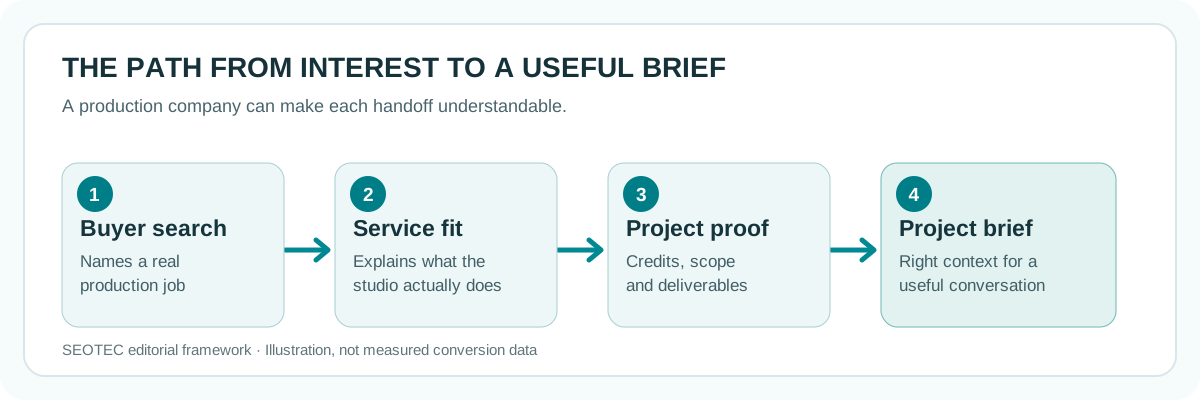
- Buyer search
Names a real production job.
- Service fit
Explains what the studio actually does.
- Project proof
Credits, scope and deliverables.
- Project brief
The right context for a useful conversation.
A useful visitor journey can be drawn without inventing a new software platform:
Relevant buyer search → service page → project proof → contextual inquiry → qualification → scoped conversation.
Each step should be able to answer a different question.
A search result for “corporate video production company” takes someone to an actual service, not a miscellaneous showreel. The service page describes the offer and links to a completed corporate project whose scope is clear. The project page answers what the team delivered. The inquiry link asks for a corporate brief rather than a generic message. When the company responds, it knows enough to decide whether to propose a call, request missing details or decline work outside its capabilities.
There is no requirement that every visitor follow this exact sequence. Someone referred by a trusted agency may arrive directly at a project page. Someone who already knows the studio may use its contact page immediately. The architecture should support these shorter routes, not force a funnel for its own sake.
What matters is that a buyer who does need reassurance can find it without guessing.
For the website owner, this also provides a diagnostic map. If a service page attracts relevant visitors but they rarely reach the proof, perhaps the relationship between offer and examples is unclear. If project pages are well viewed but inquiries mostly ask about services the studio does not offer, the work examples may be too broad or insufficiently credited. Neither observation can be established from traffic numbers alone; the inquiry content and the team’s actual sales experience matter.
Local SEO belongs to the work the crew can deliver
A Brooklyn-based crew that regularly films on location may be eligible for a Google Business Profile, while a remote-only freelance post-production operation may have a different local-presence situation. Eligibility depends on the actual business model, not an SEO consultant’s wish for a Maps result.
Google’s Business Profile guidelines distinguish real staffed customer-facing locations from service-area businesses that travel to customers. A virtual office cannot be presented as a staffed customer location merely to gain an address. Service-area businesses should use accurate areas and hide a residential address when applicable. These requirements are relevant to a production crew that travels to client locations, but they do not grant eligibility to every individual freelancer or online-only operation.
For the buyer, actual geographic reach also belongs on the service page. “Available for interviews across the five boroughs” is useful only if that is true; “New York video production” repeated across pages is not evidence of crew coverage. If the company brings equipment and crew to New Jersey, explain the practical area and any travel planning. If it edits files remotely, explain the handoff instead of forcing a “near me” message.
Location has value when it changes availability, logistics or the client’s decision. It should not be used as decorative search copy.
Video indexing is worthwhile, but it cannot qualify a client
Production companies naturally care about whether their videos can appear in search. Google’s Video SEO Best Practices explain why an individual watch page needs a clearly dominant video, an accessible thumbnail, consistent metadata and crawlable media resources. VideoObject structured data can describe a video and support eligibility for features, provided it reflects the actual page and content.
Those are legitimate technical checks. They answer whether Google can understand and potentially surface a video, not whether the viewer has authority to commission a brand film or whether the studio fits the project.
This creates two different performance questions. For the media itself, the studio may look at eligible video impressions and engagement. For the business, it needs to understand which service and proof pages lead to appropriate conversations. A popular documentary clip can attract students, fans, journalists and filmmakers. A smaller service page might attract a procurement manager with a real brief. Popularity and commercial fit must be measured separately.
When videos are embedded from a third-party player, the website still needs readable text about the service and project. A player may be visually impressive, but it cannot replace accurate information about what the team does. Do not hide all of the page’s commercial meaning behind a “Play” control.
SEO is only one channel in a production company’s project pipeline
A production team may receive its best work through referrals from agencies, returning clients, LinkedIn connections, procurement lists, partnerships, targeted outreach, events or search. The practical question is not which channel sounds modern. It is where the studio can present relevant proof to a suitable buyer at the right stage.
Organic search is useful when prospective clients routinely name the service they need. Corporate video production, commercial editing and event video services can have understandable purchase language. Whether a particular company can earn qualified traffic depends on real demand, the current site and competition. Search Console results should be inspected before assuming a keyword has value.
Agency and client referrals can be especially important when the work requires trust or a known production role. A referring producer already knows whether the studio can manage a crew, edit against an established pipeline or handle client approvals. The website should still help with due diligence: it needs accurate service pages and appropriate project proof that the referral can share.
Paid search may suit a well-defined service and available capacity, particularly if the studio can respond promptly and measure the value of a qualified brief. Sending paid traffic to a generic montage with no service context is an expensive way to discover that the landing page is unfinished. Cost per click and cost per inquiry are only meaningful alongside project fit and eventual value; none are supplied here as market averages.
Local discovery and Maps matter when the business is eligible and the buyer’s decision is geographically constrained. They are less central for remote editing across state lines or documentary partnerships sourced through networks. The site should accurately represent what is available instead of manufacturing local relevance.
A production company does not have to pick one channel forever. A sensible review looks at the kinds of paid projects won, how each buyer first arrived and the time or expense required to move from introduction to an actual brief. The website can support every channel without pretending that every channel started with Google.
Measure inquiries that fit the business, not just clicks on the reel
Google Search Console can show impressions and clicks for search queries and pages. It does not know whether the visitor later requested an approved, profitable production. Google Analytics can measure configured website events, but a form submission is not automatically a qualified job.
Google’s GA4 recommended lead-generation events distinguish a generated lead from a qualified lead, a disqualified lead and a later commercial conversion. Those stages are useful concepts for a production company even if it has no CRM at all. The team can begin with a careful shared record of actual inquiries and gradually connect the stages to analytics where consent, implementation and business workflow allow.
Define a qualified project inquiry before comparing channels. A reasonable working definition might be: the request describes a service the company offers, identifies a plausible project or client need, contains enough schedule or delivery information to respond, and has a credible route to a commercial conversation. Each studio needs its own criteria. A referral partnership, a documentary commission and a corporate video booking need not share one price threshold.
Then separate the following events rather than reporting one number as “leads”:
- Inquiry received: a completed contact request, call or approved partner referral. Record the actual source only when known.
- Project fit checked: the team has decided whether the service, timing, location and responsibilities match its capabilities.
- Scope discussion: the prospect and producer have clarified deliverables, process and an appropriate next commercial step.
- Proposal or confirmed engagement: a written scope is sent or a project is accepted. Do not count a proposal as revenue.
This is an operational map, not a demand for a new dashboard. A small studio could follow it in its existing project tracker or inbox. The point is to stop letting a large number of low-fit contacts hide the quality of the inquiries that matter.
Use the numbers carefully. A page may receive more clicks because its topic has broad educational appeal. That does not prove it contributes more qualified work. Another page may appear to have a high inquiry rate from a handful of visits; with such a small denominator, the result is fragile. Compare completed periods and check whether the form and reply process changed in the meantime.
A useful owner-facing report might read: “Corporate interview pages were discovered through search; several inquiries asked for a similar deliverable; the team qualified these specific requests.” That is a much stronger business statement than “Our video SEO went up 40%,” unless the underlying figures, denominators and attribution are genuinely available.
What to fix first on an existing production site
The sequence should follow the largest confirmed commercial gap rather than a standardized package of twenty SEO tasks.
Begin by reviewing the work the production company actually wants to sell. Make an honest list of current capabilities, excluded job types, real crew availability, geographic reach, post-production responsibilities and approved project examples. This may expose a larger business decision: perhaps the most prestigious reel footage belongs to a service the studio no longer provides. That is a portfolio-positioning issue before it is an SEO issue.
Next, examine the homepage and the main service path as a new buyer would. Can someone tell which services are offered without pressing Play? Is there a normal HTML link to each substantial service page? Does the client see a relevant example and find a sensible inquiry route? Google’s link guidance emphasizes real, descriptive links; the practical value is equally simple for the person navigating the website.
Then select a few representative projects and give them enough truthful context to support a buying decision. Prioritize examples with appropriate usage permissions, clear team roles and deliverables aligned to the work being marketed. A documentary partner and a commercial brand manager may need different proof, so a single “featured projects” row is not always enough.
The inquiry flow comes next. Check that the form works, messages arrive, replies are assigned and prospective clients know what happens after submission. A broken contact route makes every upstream improvement harder to evaluate. Test actual completion before interpreting an analytics event as proof that the studio received a usable brief.
Finally, review search and inquiry signals over an appropriately completed period. Use them to decide whether the next effort belongs in a service page, a stronger project explanation, a clearer intake path, local information or channel allocation. Do not automatically publish twenty short city pages or re-edit all video descriptions because the first report looks thin.
The value of this order is that each improvement resolves a different uncertainty. It also makes later measurement more intelligible.
The real next step for a production company owner
A great reel is supposed to impress. It should not have to explain the entire business. That is the job of the pages, project evidence and contact path around it.
If visitors enjoy the work yet few submit serious briefs, examine the handoffs: Which service did the visitor think you offer? Which project showed you could deliver it? What information did the inquiry form make easy to send? A broken handoff may be more important than another minute of showreel or another keyword in the page title.
A production company can make that path clearer without sacrificing its creative identity. Good portfolio work gives the buyer a reason to pay attention. Accurate service context gives them a reason to inquire.
Not sure where a production website loses suitable prospects? Discuss a website and project-inquiry path review with SEOTEC. If the problem is wider than the inquiry flow, our website design and development service explains how we plan websites around their real business jobs. This is a human review, not an instant automated promise.
Sources and scope
The following official documentation supports only the specific technical distinctions described above; the commercial recommendations and six-row project-intent matrix are SEOTEC’s editorial framework, not a Google ranking formula.
- Google Search Central: SEO Starter Guide and Link Best Practices, reviewed November 11, 2026.
- Google Search Central: Video SEO Best Practices and Video structured data, reviewed November 11, 2026.
- Google Business Profile: Guidelines for representing your business, reviewed November 11, 2026.
- Google Analytics: Recommended events for lead generation, reviewed November 11, 2026.
- Google Search Console: Search Performance Report, reviewed November 11, 2026.