
Travel Agency Websites: Should Visitors Book, Request a Trip Plan, or Talk to an Advisor?
Published
A traveler who wants two tickets for a scheduled walking tour and a family planning three weeks across Italy should not be asked to take the same next step. The first person might be ready to choose a date, see an accurate total and pay. The second may need to establish whether an advisor handles multi-city travel, what planning involves and whether a consultation is worth having.
Yet travel websites often put both people in front of the same button. Sometimes it says Book Now, even when nothing can actually be booked. Sometimes it says Contact Us, even when the visitor is ready to purchase a specific departure. More traffic will expose that mismatch to more people. It will not correct it.
For an agency owner considering website development or SEO, the useful starting point is the type of business being sold. An independent travel advisor, a group-travel planner and an operator with live tour inventory may all appear in search results for travel-related questions. Their websites have different jobs. Before deciding which pages to create or what software to buy, decide what a successful visitor should reasonably be able to do next.
An inquiry is not a failed booking
An independent advisor may arrange cruises, resorts, specialist destinations or custom itineraries through suppliers. The traveler is buying judgment, coordination, access to an actual booking process and a continuing relationship. Even if the site shows hundreds of travel products, the advisor might not control live availability, final pricing or the supplier's confirmation.
In that business, a well-qualified consultation request can be the correct online result. The final purchase may take place later through the supplier or the advisor's booking system. A website that captures the right information and routes the request to the right person can be doing its job without processing a payment at that moment.
The reverse is true for an operator selling a timed, fixed-capacity activity. If the company controls availability, pricing and reservations for a two-hour tour, forcing every ready customer to call an agent can introduce an unnecessary delay. The website can reasonably be expected to show dates, inclusions, restrictions and an actual booking path.
The difficult cases sit between those models. A multi-day departure may offer a reservation request or deposit before final confirmation. A group holiday may have a published starting price while requiring a custom proposal. An advisor may market a cruise sailing but still need to confirm cabin availability and supplier terms. The right call to action depends on what can honestly happen after the click, not which button looks more decisive in a design mockup.
Three paths worth separating
Talk to an advisor. A traveler wants to establish fit, scope and whether the person or agency can help. The website should explain specialization and the next conversation. A successful action is an appropriate request for consultation, not an invented instant booking.
Request a trip plan or quote. The customer has a recognizable trip in mind but needs supplier checks, options or a proposal. The site can collect a useful brief, with a clear explanation of what happens next and whether planning fees apply. The meaningful next result is a qualified request that leads to a proposal.
Reserve an available departure. The product is sufficiently fixed to present real dates, capacity, terms and checkout. A customer can see what is included and purchase or place a legitimate hold. The result to measure is a real reservation or payment, subject to the operator's actual process.
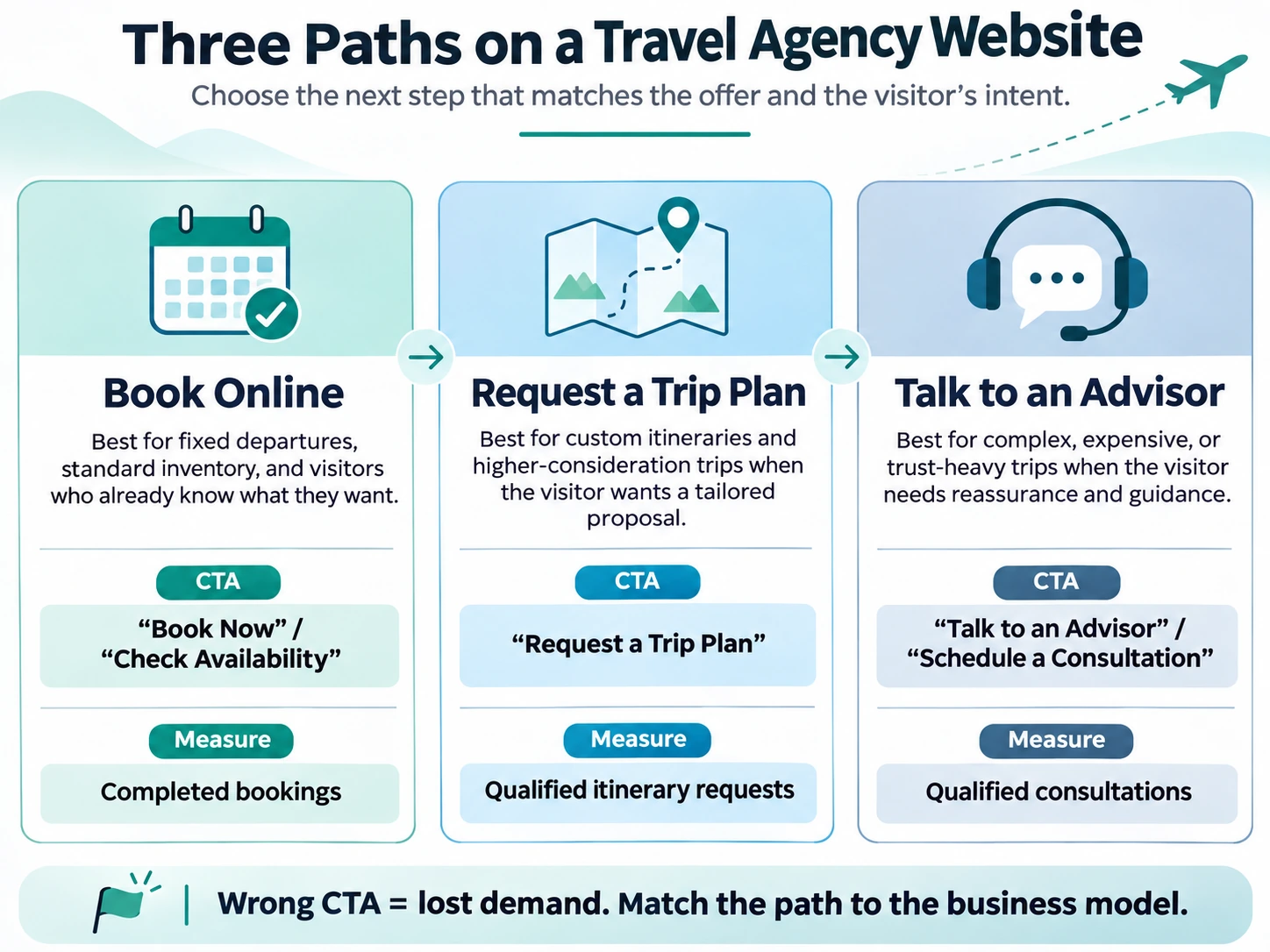
These paths can coexist on a single business website. They do not need to lead to three separate brands, three competing homepages or an elaborate new software subscription.
The page has to answer a question before asking for a lead
Consider a specialist cruise advisor. A visitor searching for help planning a family cruise needs to know whether the advisor handles family groups, which kinds of lines or itineraries are within scope and what the working relationship includes. A generic hero saying Explore the World With Us answers almost none of that.
A more useful service page might explain how the advisor compares cabin choices, group arrangements and travel dates, whether an initial consultation is available, and how supplier quotes and later changes are handled. The information is commercially relevant because it lets the wrong visitor leave early and the right one ask a specific question.
It also changes what counts as a good inquiry. Ten vague messages saying “send me deals” and two detailed requests from travelers who match the business's specialization do not have the same value to an advisor. Counting form submissions without considering suitability can make a website appear successful while the owner's calendar fills with poor-fit conversations.
A trip request form can ask for a destination or region, preferred dates or flexibility, number of travelers, the type of experience sought and a way to reply. Those fields are useful only if the advisor actually uses them. If a company first needs to check whether a traveler wants a consultation, a short request may work better than a long form that tries to imitate the full travel-planning interview.
Privacy matters here too. A first inquiry rarely needs passport numbers, payment-card details or other sensitive travel documents. Those belong in an appropriate, secured part of the business process when they are genuinely required, not in a convenient general-purpose contact form.
Seven travel offers, seven different next steps
The following is a decision framework, not a table of industry conversion averages. Its purpose is to help an owner commission the correct website function and understand the business result being measured.
| Business offer | What the visitor must establish | Appropriate next step | Business outcome to record |
|---|---|---|---|
| Custom luxury or multi-city itinerary | Whether the advisor handles their destinations, travelers and planning scope; what fees or minimums apply | Relevant trip request, then consultation or planning brief | Suitable request → accepted brief → proposal → supplier-confirmed sale |
| Cruise specialist or destination advisor | Specialization, service relationship and who handles supplier quotes and changes | Advisor consultation or verified quote request | Qualified consultation, then booked trip when confirmed |
| Destination wedding, retreat or group travel | Group size, dates, responsibilities, lead time and proposal dependencies | Group inquiry followed by a scoped proposal | Qualified group opportunity → proposal → contract |
| Franchise or hosted advisor with shared supplier content | What this particular advisor knows and personally manages beyond the shared catalog | Contact the actual advisor, not an unowned generic lead inbox | Direct advisor inquiries distinguished from consortium-supplied leads |
| Fixed-price day tour or timed activity | Live date, space, meeting point, price, restrictions and terms | Real-time reservation and payment, if those functions exist | Confirmed booking, cancellation and attendance recorded separately |
| Multi-day tour with fixed departures | Departure dates, itinerary, inclusions, deposit and availability | Reservation request or deposit matched to the operator's process | Qualified departure inquiry, hold, deposit and confirmed traveler distinguished |
| Package promoted from a third-party supplier | Who sets the actual price, availability and contractual terms | Supplier-verified booking path or request for a real quote | Quote requested → supplier confirmed → agency sale |
The important column is not the button. It is what the business can actually deliver after that button is used. A travel advisor should not promise a confirmed room or cruise cabin merely because a website builder makes it easy to display a checkout widget. Equally, a tour operator should not have to manually reply to every ready customer if its reservations system can safely complete the transaction.
Where the handoff loses the customer
A website's performance is usually discussed in visits, inquiry totals or bookings. Those numbers become much more useful when attached to an actual handoff.
First, the offer may attract the wrong question. A page about “all-inclusive vacations” can bring visitors looking for self-serve bargain inventory while the agency sells complex family itineraries with a planning fee. Stronger copy about the advisor's real specialty may reduce some low-fit inquiries while making the remaining conversations more productive. The owner should judge the page by the customers it is supposed to serve, not traffic volume alone.
Second, the site may ask for a commitment before establishing trust. “Book your dream vacation now” is a heavy promise when the business has yet to explain who will plan it, whether there is a fee, how changes are handled or what happens after submission. For a higher-consideration trip, a clear description of the service and a credible next conversation can be more appropriate than a forced sale.
Third, a qualified request may disappear after leaving the website. An advisor receives a reasonable family-cruise brief on Friday but has no clear follow-up responsibility, response process or way to distinguish that request from a general newsletter signup. The website's analytics may show a conversion, yet the opportunity gets stuck at the next desk. Rebuilding page layouts will not solve an office handoff no one owns.
Those are different problems, and they justify different purchases. The first points toward positioning, content and relevant search demand. The second toward explaining the offer and simplifying the next action. The third toward lead handling and operational follow-through. A developer can improve a form; the agency still has to decide who responds and what counts as a qualified request.
When an actual booking engine earns its place
A booking engine has a straightforward case when the business has bookable inventory and can display truthful availability. Visitors should be able to understand what they are purchasing, the start time or departure, total applicable price, important restrictions and cancellation terms before paying. Availability shown on the website should be connected to the system that confirms the reservation. If those conditions are missing, the appearance of a checkout is not the same as a functioning booking service.
A tour operator selling set departures may also need a sensible mobile experience for date selection and group size, an understandable deposit process and a confirmation that arrives at the appropriate step. The right technical purchase could be an integration or repair rather than a new promotional website. This is where website design and development should be judged on the working booking path, not a portfolio of attractive landing pages.
For an advisor selling custom itineraries, the more valuable feature may be a structured trip brief, a consultation calendar that reflects real availability, or a reliable link between requests and the advisor's customer records. Those are not second-rate substitutes for ecommerce. They are tools for the actual sale.
Third-party tour widgets and supplier-fed catalogs introduce a further question: who owns the customer relationship? A shared listing can be convenient for travelers, but its content may be identical across many advisor websites, and inquiries may go to a supplier or host instead of the local advisor. Before paying to integrate a feed, establish which parts of the experience the agency can genuinely control: its service explanation, original destination knowledge, inquiry routing and follow-up. Supplier product text alone cannot do that work.
Search visibility has to match the agency's real service
An advisor's website can have a sensible customer journey and still be difficult to discover for the services that matter. That is when SEO is a plausible investment. But the relevant pages are not necessarily fifty thin destination pages with a city name inserted into each title.
A specialist advisor may have one strong page explaining a family-cruise planning service, a genuinely useful explanation of what the advisor does before and after booking, and selected destination or trip-type material grounded in actual knowledge. A tour operator may have product pages for real tours, dates and itineraries. Each page should exist because it answers a distinct traveler question or describes a genuine offer. Search engines do not need a new URL for every combination of cruise line, city and keyword.
Local visibility needs special care. A business serving clients remotely is not automatically eligible for a Google Business Profile. Google's eligibility guidance concerns qualifying real-world contact and location/service-area operations. A virtual office or online-only business does not acquire eligibility by adding a map pin. For an agency that genuinely qualifies, business identity and local details may be worth maintaining; for one that does not, the search strategy should start with its actual expertise and web presence instead. See Google's Business Profile eligibility guidance and our SEO and Local Search service.
A visitor researching a complicated trip may also find the agency through a helpful explanation rather than a service page. This creates a natural connection between editorial material and commercial pages, provided the article helps the traveler and makes the next step clear. Writing a generic destination page merely to surround a booking button with more keywords is unlikely to fix the underlying purchase decision.
What a travel business should measure, from search to sale
Google Search Console shows whether and how pages appear and receive clicks from Google Search. Website analytics can record visits, navigation and configured actions. Neither system, by itself, establishes that a traveler became a paying client.
The handoff can be described in five distinct records:
- Discovery: the relevant service or trip page received impressions, clicks or visits from an identifiable source.
- First action: a person requested an advisor conversation, submitted a qualified trip brief or began an actual booking path.
- Qualification: the business established that the travel request fits its offer, timing and capacity.
- Commercial progress: the advisor issued a proposal, the traveler placed a deposit or a reservation was held using the real system.
- Confirmed outcome: a supplier or operator confirmed the actual booking, and the business can identify it through its records.
Not every business needs a complicated dashboard to observe these stages. A small specialist agency can use a consistent inquiry category and existing CRM fields. A tour operator may already have reservation, payment and cancellation records. The important part is using the same definitions when judging what improved.
Suppose a site generates more trip requests after a page revision, but the proportion accepted by an advisor declines. The increased form count may be real. It is not sufficient evidence that the business is acquiring better clients. Conversely, fewer but better-matched requests can be commercially useful even if a dashboard shows fewer “conversions.” The website's objective should be explicit before anyone celebrates or rejects the change.
When a customer sees content on the site, contacts the agency days later and books through a supplier, the source-to-sale connection may be incomplete. Record that uncertainty instead of attributing every later booking to the last form or page viewed. The appropriate report separates observable website activity from confirmed business outcomes.
What should the owner commission first?
If qualified conversations already become trips but too few of the right travelers find the agency, investigate search demand, service pages and discoverability. A focused SEO review makes more sense than rebuilding a form that already works.
If traffic reaches the website but requests are vague, begin with the offer and the next action. Make it possible to understand what the advisor does, what kind of travel is a fit, what information a traveler should provide and what will happen next. Consider the booking or consultation tools only after that decision is made.
If plenty of suitable requests come in but proposals, responses and confirmations stall, look beyond the website. Agree on response ownership and how supplier checks, quotes and accepted bookings are recorded. The next improvement may be operational rather than another SEO or design package.
If the business has actual bookable tours but people cannot select dates or complete checkout on phones, the first job is probably to fix the reservation experience. More destination articles will not make a broken availability calendar function.
An initial website review should therefore identify the specific stage that is failing, the evidence behind that conclusion and the change the business can verify afterward. That is how a travel agency can decide whether to spend on content, SEO, website development, booking integration or lead handling without buying several versions of the same problem.
The practical question is not whether every travel business should have a Book Now button. It is whether the next action on the website leads to the next genuine step in that business's sale. A consultation, qualified brief and confirmed reservation can each be the right outcome. The website should know which one it is asking for.
Request a free initial SEO + AI website review if you want to establish where your current pages and customer journey are helping, and where the next investment would actually address a gap.